
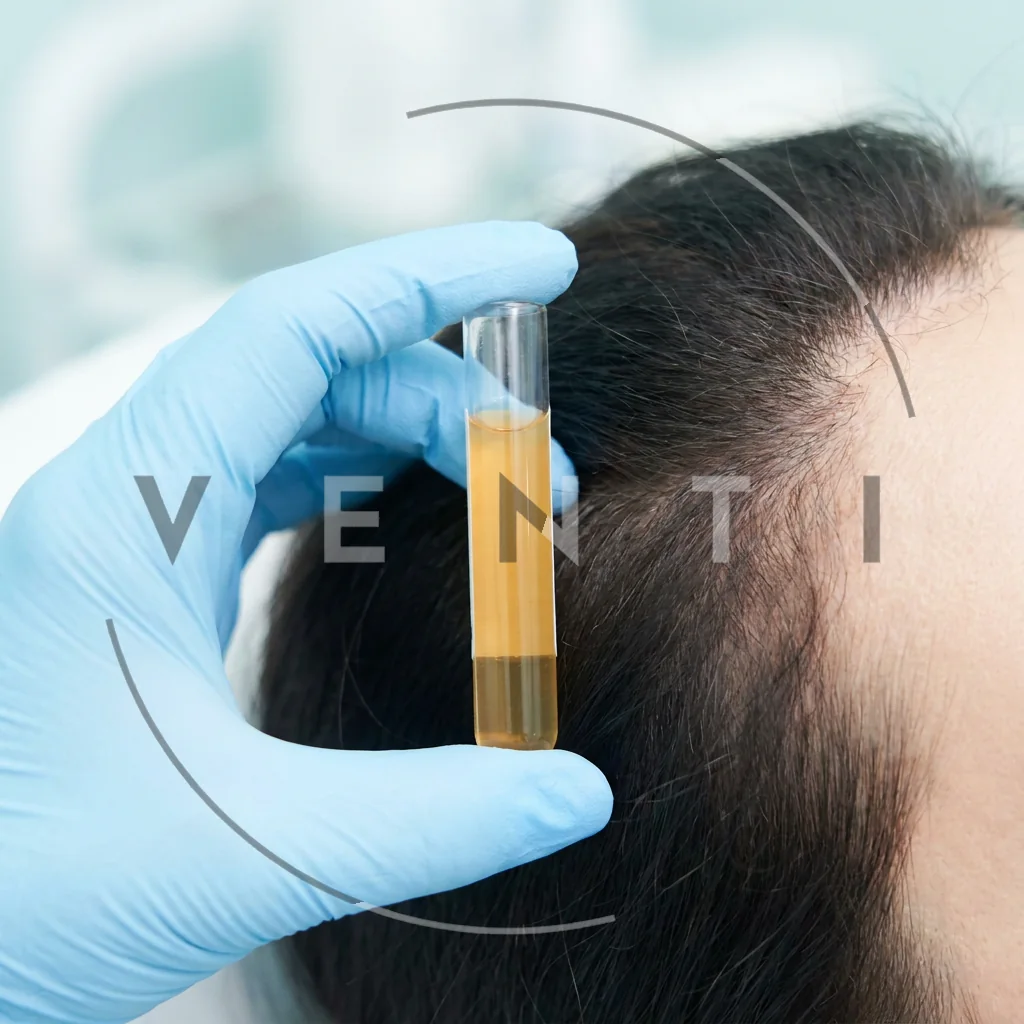
Platelet-Rich Plasma (PRP) therapy is a regenerative, minimally invasive treatment that harnesses the healing power of your own blood to revitalize the scalp and encourage healthier hair. Rather than relying on synthetic compounds, PRP concentrates the growth factors that your body already produces and delivers them precisely where they are needed most — the hair follicles. At our combined hair and dental clinic in Istanbul, PRP is used both as a standalone solution for early-stage thinning and as a powerful complement to hair transplant surgery.
What Is PRP and How Does It Work?
Your blood contains platelets that are rich in growth factors, cytokines, and proteins responsible for tissue repair and cell regeneration. When these platelets are concentrated and reintroduced into the scalp, they signal dormant or weakened follicles to re-enter an active growth phase.
The biological goal of PRP is threefold: improve blood supply to the follicle, prolong the growth (anagen) phase of the hair cycle, and create a healthier scalp environment in which existing and transplanted hairs can thrive. Because the plasma is derived entirely from your own body, the risk of allergic reaction or rejection is extremely low.
The PRP Procedure Step by Step
A typical session is straightforward and takes roughly 45 to 60 minutes:
- Blood draw — A small sample of blood, similar to a routine lab test, is collected from your arm.
- Centrifugation — The sample is spun in a high-speed centrifuge to separate the platelet-rich plasma from red blood cells and other components.
- Preparation — The concentrated plasma is carefully extracted, sometimes activated to maximize the release of growth factors.
- Scalp injection — Using fine needles, the plasma is injected into targeted areas of thinning, often after a topical anaesthetic to keep you comfortable.
There are no incisions and no stitches, and most patients return to their normal routine immediately afterward.
Who Is a Good Candidate for PRP?
PRP is most effective for individuals in the early to moderate stages of hair loss, where follicles are weakened but not completely gone. Ideal candidates include:
- Men and women noticing diffuse thinning or reduced hair density
- Patients with androgenetic alopecia in its earlier phases
- Transplant patients who want to improve graft survival and speed healing
- Those seeking a non-surgical way to strengthen and protect existing hair
PRP is generally not suitable for areas that are fully bald, since it cannot regenerate follicles that no longer exist. A consultation allows us to assess your scalp and set realistic expectations.
PRP Combined With Hair Transplantation
When paired with a hair transplant, PRP becomes a valuable supportive therapy. Applying plasma to the treated area can help reduce inflammation, support faster healing of the donor and recipient zones, and improve the survival rate of newly placed grafts. Many patients also report thicker, healthier regrowth in the surrounding native hair. We tailor the timing and number of PRP sessions to align with your transplant recovery.
Results, Sessions and Realistic Expectations
PRP is not an instant fix; it works gradually as your follicles respond to the growth factors. Most treatment plans involve an initial series of three to four sessions spaced several weeks apart, followed by maintenance sessions over the year. Visible improvements in density and hair quality typically emerge over a few months.
Results vary from person to person and depend on the stage of hair loss, overall health, and consistency of treatment. PRP can slow shedding and enhance the hairs you have, but it does not stop the underlying causes of genetic hair loss permanently, which is why maintenance and a personalized plan matter.
Safety, Comfort and Aftercare
Because PRP uses your own blood, it carries a strong safety profile with minimal downtime. Mild redness, tenderness, or slight swelling at the injection sites can occur and usually resolves within a day or two. We advise avoiding harsh hair products, intense heat, and strenuous exercise for the first 24–48 hours. Our team provides clear aftercare guidance so you can protect your investment and support the healing process.
FAQ
Is PRP treatment painful?
Discomfort is minimal. We apply a topical anaesthetic before the injections, and most patients describe only a mild stinging or pressure sensation. Any tenderness usually fades within a day.
How many PRP sessions will I need?
Most patients start with three to four sessions spaced a few weeks apart, followed by periodic maintenance sessions. Your exact plan depends on the stage of hair loss and your individual response, which we assess during consultation.
Can PRP regrow hair on completely bald areas?
No. PRP strengthens and stimulates existing but weakened follicles. It cannot create new follicles where they have been permanently lost, so fully bald zones typically require a hair transplant instead.
Related Treatments
- Hair Mesotherapy in Istanbul: Non-Surgical Treatment to Strengthen Thinning Hair
- Stem Cell Hair Transplant in Istanbul: Regenerative Hair Restoration
- FUE Hair Transplant in Istanbul: A Scar-Free Path to Natural Hair Restoration
- Hair Transplant Cost: Italy vs Turkey (2026)
Related articles
- Hair Mesotherapy in Istanbul: Non-Surgical Treatment to Strengthen Thinning Hair
- Afro Female Hair Transplant in Istanbul: Specialist Care for Curly Textured Hair
- Stem Cell Hair Transplant in Istanbul: Regenerative Hair Restoration
- Eyebrow Transplant in Istanbul: Natural, Permanent Brow Restoration
- Traction Alopecia Treatment for Black Women: Restore Thinning Edges in Istanbul
