
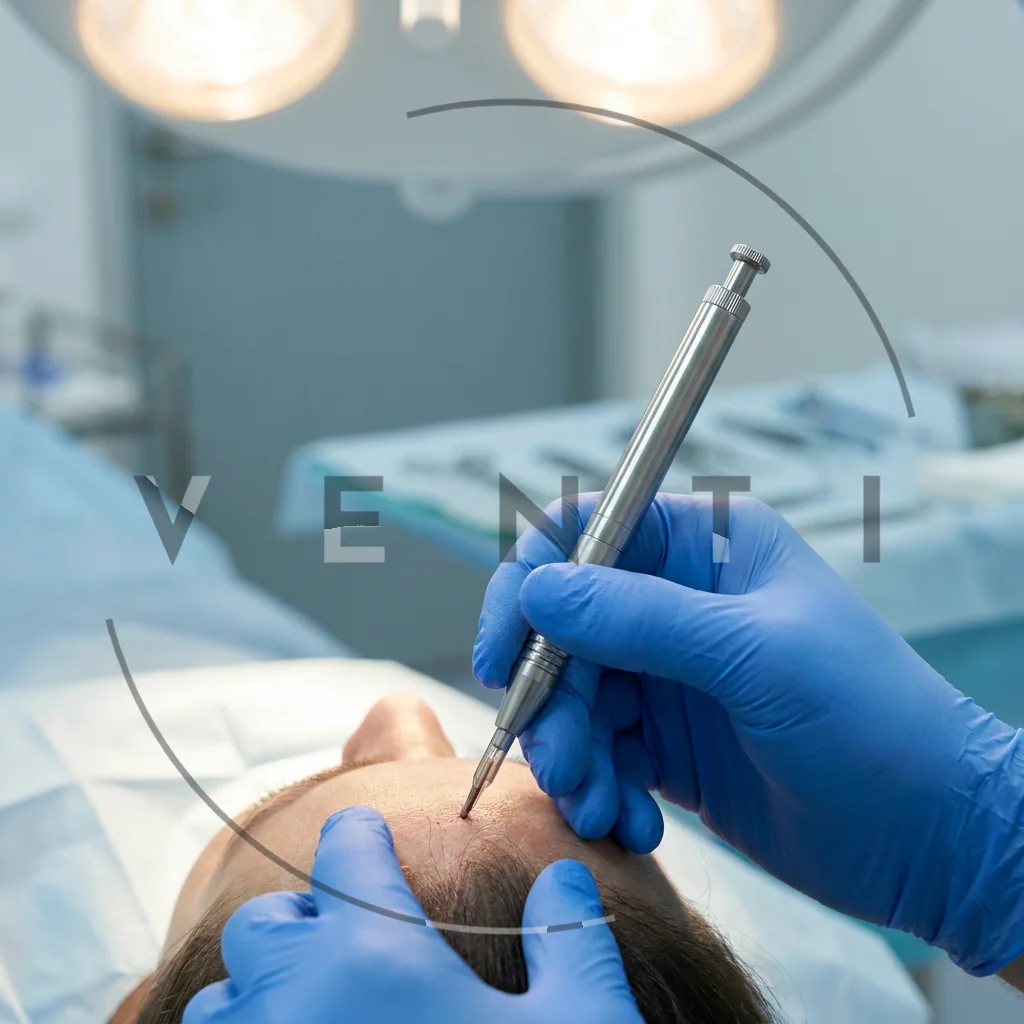
Direct Hair Implantation (DHI) represents one of the most refined approaches to modern hair restoration. It is designed for patients who want maximum control over graft placement, high follicle survival, and a hairline that looks completely natural. At Venti Hair Center in Istanbul, our medical team uses DHI to address everything from a receding hairline to thinning in the mid-scalp and crown, with each plan tailored to the individual.
This page explains exactly how DHI works, who it suits best, what the treatment day looks like, and what kind of results you can realistically expect — so you can make an informed decision before traveling for your procedure.
What Is DHI and How Does It Differ From FUE?
DHI is an evolution of the Follicular Unit Extraction (FUE) family of techniques. In both methods, individual follicular units are harvested one by one from the donor area at the back and sides of the head. The key difference lies in the implantation stage.
With classic FUE, the surgeon first creates tiny channels (recipient sites) in the scalp and then places the grafts into those openings. DHI combines these two steps into one. Using a specialized Choi implanter pen, the follicle is loaded into the device and inserted directly into the scalp in a single movement — no separate channel-opening step is required.
This approach gives the surgeon precise command over the depth, angle, and direction of every graft, which is essential for mimicking the way hair naturally grows, particularly along the frontal hairline.
Key Advantages of the DHI Technique
- Higher graft survival: Because follicles spend less time outside the body between extraction and implantation, their viability is better preserved.
- Natural-looking density: The Choi pen allows grafts to be placed very close together at the correct angle, producing a seamless, dense result.
- Minimal shaving: DHI often requires shaving only the donor area rather than the entire head, making it a practical option for women and for men who prefer to keep their existing hairstyle.
- Reduced bleeding and trauma: The single-step insertion can mean less manipulation of the scalp.
- Versatile placement: While ideal for hairline design, DHI also performs well in the mid-scalp and crown regions.
At Venti Hair Center, experienced specialists can typically implant 3,000–3,500 grafts in a single session with DHI, depending on donor capacity and the area to be covered.
Are You a Good Candidate for DHI?
DHI is well suited to patients who:
- Have a stable and healthy donor area with sufficient follicles
- Are seeking precise, high-density restoration of the hairline
- Want to avoid full-head shaving
- Are addressing early to moderate hair loss, or specific thinning zones
DHI may be less ideal for patients requiring very large numbers of grafts in one session, where another technique might be more time-efficient. The best way to confirm suitability is a personal consultation, where our team assesses your hair type, the extent of loss, and your goals. Patients with certain medical conditions or unrealistic expectations are advised honestly during this stage.
The DHI Procedure Step by Step
- Consultation and hairline design: Your scalp and donor area are evaluated, the number of grafts is estimated, and a natural hairline is designed in agreement with you.
- Preparation and local anesthesia: The donor area is prepared and local anesthesia is applied for comfort throughout the session.
- Follicle extraction: Individual grafts are carefully harvested from the donor region.
- Loading and implantation: Each follicle is placed into a Choi pen and implanted directly into the recipient area at the precise depth, angle, and direction.
- Aftercare briefing: You receive detailed instructions for the recovery period and follow-up support.
A session generally takes several hours and is performed under local anesthesia, allowing you to remain awake and comfortable.
Recovery and What to Expect Afterwards
Mild redness, slight swelling, and small scabs in the treated areas are normal in the first days and typically settle within one to two weeks. Most patients return to everyday activities quickly, though strenuous exercise, direct sun, and swimming should be avoided for a few weeks.
It is important to understand the natural timeline: the transplanted hairs usually shed within the first few weeks (a normal phase called shock loss), after which new growth begins. Visible improvement appears around 3–4 months, with the majority of results developing by 8–12 months and full maturity often around 12–18 months. Results are long-lasting because the transplanted follicles are resistant to the hormone responsible for typical hair loss.
No ethical clinic can guarantee a fixed graft count of regrowth, but with a healthy donor area and proper aftercare, DHI delivers reliable, natural-looking density.
Why Choose Venti Hair Center in Istanbul
Istanbul is a leading destination for hair restoration thanks to its experienced surgical teams and accessible pricing. At Venti Hair Center, every treatment plan is customized to your hair characteristics, facial structure, and personal objectives. We combine Choi pen technology with medical expertise and attentive aftercare to support results that are both natural and durable, guiding international patients through each stage of their journey.
FAQ
Does a DHI hair transplant require shaving my whole head?
Not usually. One of the benefits of DHI is that it often requires shaving only the donor area, allowing many patients — especially women — to keep their existing hairstyle. The exact approach depends on the size of the area being treated, which is discussed during your consultation.
How long until I see results from DHI?
After an initial shedding phase, new growth typically begins around 3–4 months. Most of the result develops between 8 and 12 months, with full maturity often reached around 12–18 months. Patience during the early stages is normal and expected.
Is DHI painful?
The procedure is performed under local anesthesia, so you should feel little to no pain during the session. Some mild tenderness, redness, or minor swelling may occur in the first days afterward and usually resolves within one to two weeks.
Related Treatments
- FUE Hair Transplant in Istanbul: A Scar-Free Path to Natural Hair Restoration
- FUE vs DHI Hair Transplant: A Complete 2026 Comparison Guide
- Unshaven Hair Transplant in Istanbul: Discreet Hair Restoration Without Shaving
- Hair Transplant Cost: Italy vs Turkey (2026)
Related articles
- Beard & Mustache Transplant in Istanbul: Natural, Permanent Facial Hair Restoration
- Unshaven Hair Transplant in Istanbul: Discreet Hair Restoration Without Shaving
- Hair Mesotherapy in Istanbul: Non-Surgical Treatment to Strengthen Thinning Hair
- Stem Cell Hair Transplant in Istanbul: Regenerative Hair Restoration
- FUE Hair Transplant in Istanbul: A Scar-Free Path to Natural Hair Restoration
Celebrity Hair Transplant Case Studies
- Jude Law’s Hair Transformation: Unpacking the Real Causes of His Hair Loss
- Wayne Rooney’s Hair Transplant: How the Footballer Restored His Hairline
- Cristiano Ronaldo’s Hair: Has He Had a Hair Transplant?
- Elon Musk’s Hair: Did He Have a Hair Transplant?
- LeBron James’s Hair: Has He Had a Hair Transplant?
- David Beckham’s Hair: Has He Had a Hair Transplant?
- Matthew McConaughey’s Hair: Did He Have a Hair Transplant?
