
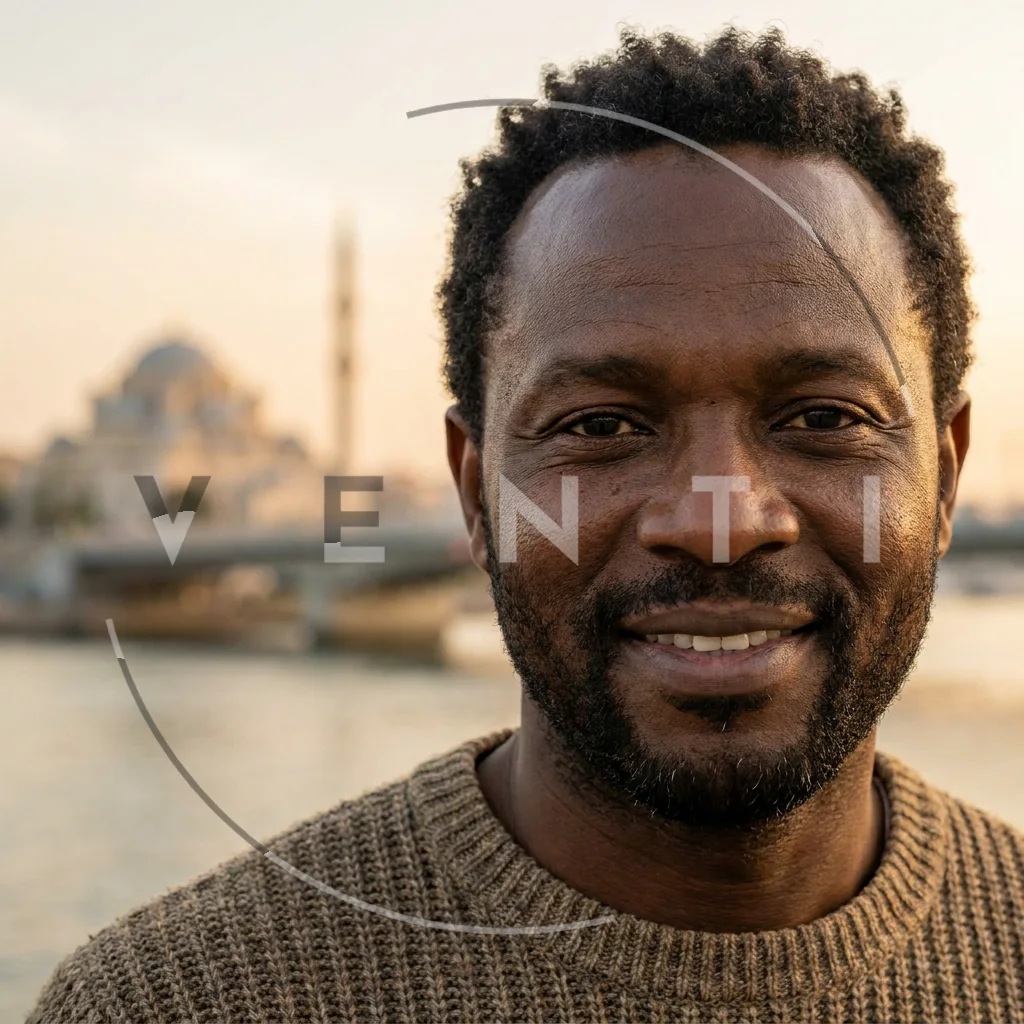
Afro-textured hair is beautiful, versatile, and remarkably full — but when it comes to hair restoration, it demands a level of expertise that not every clinic offers. The defining characteristic of Afro hair is its tight curl, which doesn’t stop at the surface of the scalp. Beneath the skin, the hair follicle itself is curved, sometimes dramatically so. This anatomical difference completely changes how a transplant must be planned and performed.
At our Istanbul clinic, our surgical team has built genuine, hands-on experience treating Afro-textured patients. We understand that a technique optimized for straight European or Asian hair simply cannot be applied identically to curly follicles. The good news is that, when handled by experienced hands, Afro hair transplants can deliver exceptionally natural, dense, and lasting results. Whether you are searching for an Afro hair transplant or a Black hair transplant, the priority is the same — a surgeon who truly understands coily, curved follicles and the specific needs of Black men and women.
Why Afro Hair Needs a Different Approach
The curved root of Afro follicles is the central challenge of the entire procedure. During extraction, the punch must follow the natural angle and curl of the follicle beneath the skin. If the surgeon misjudges this curve, the graft can be cut or transected, damaging it before it ever reaches the recipient area.
This is why graft selection, punch size, and the surgeon’s manual control matter far more for Afro patients than for any other hair type. A rushed or inexperienced extraction leads to a higher transection rate and lower survival. Our team works deliberately and carefully, prioritizing the integrity of each graft over speed.
Why We Recommend FUE Over DHI for Afro Hair
Many clinics promote the DHI method using the Choi implanter pen as their flagship technique. For Afro hair, we generally advise against it — and the reasoning is rooted in follicle anatomy.
The curved Afro follicle is difficult to load cleanly into the narrow channel of an implanter pen. Forcing a curled graft into a straight instrument increases the risk of bending, crushing, or transecting the follicle, which directly reduces survival rates. Instead, we rely on the FUE (Follicular Unit Extraction) method, where each follicle is extracted and placed with greater control. This protects the delicate root structure and supports stronger, more reliable regrowth and long-term density.
Who Is a Good Candidate?
Most adults with Afro-textured hair experiencing pattern hair loss, a receding hairline, or thinning at the crown can be considered for treatment. Ideal candidates have:
- A stable, sufficient donor area at the back and sides of the scalp
- Realistic expectations about density and coverage
- Good general health and no uncontrolled scalp conditions
- An understanding that final results develop over 12 to 18 months
One advantage unique to Afro hair is that its volume and curl create excellent coverage with comparatively fewer grafts. This means strong, full-looking results are often achievable even with a moderate transplant.
How many grafts will you need?
Most patients restoring a receding frontal hairline need roughly 1,500 to 3,000 grafts, while more advanced thinning or full crown coverage may require more. A genuine advantage of Afro-textured hair is that a single curved follicle fills more visual space than a straight one, so strong, full-looking density is often achieved with a comparatively conservative graft count.
The exact number depends on three things: the size and shape of the area being restored, your donor density at the back and sides of the scalp, and the fullness you want. During a free consultation we review high-resolution images of your scalp and give you a realistic, personalized graft estimate — never an inflated figure designed to close a sale.
How much does an Afro hair transplant cost in Istanbul?
In the United States, hair transplants are usually priced per graft at around $4 to $10 each, so a 2,500-graft procedure can climb past $15,000 before medications and follow-ups. Istanbul combines high surgical volume, advanced technology, and far lower operating costs, which is why patients travel here from across the world.
At our clinic, packages are all-inclusive — covering the procedure, aftercare, medications, hotel stay, and airport transfers. Because graft count and technique vary from person to person, we do not publish a fixed price; instead we provide an exact, personalized quote after a free, no-obligation consultation. Patients addressing both their hairline and their smile in one trip can also explore our combined hair transplant and dental makeover for additional savings.
The Procedure Step by Step
- Consultation and planning — We assess your curl type, scalp elasticity, donor capacity, and hair loss pattern, then design a natural hairline that suits your facial features.
- Donor preparation — The donor area is trimmed and local anesthesia is applied for comfort.
- Careful FUE extraction — Grafts are harvested one by one, following the curve of each follicle to minimize damage.
- Channel opening — Recipient sites are created at angles and directions that match your natural curl growth pattern.
- Implantation — Grafts are placed with precision to build natural density and a seamless hairline.
Can it be combined with a beard transplant?
Yes. A beard or moustache transplant can be performed in the same session as your hairline restoration, and combining the two is common, practical, and cost-effective. Because scalp donor hair shares the coarse character of facial hair, it integrates naturally into the beard area. Combining procedures requires careful donor planning to avoid over-harvesting, but for most patients with healthy donor reserves both goals are achievable in a single visit — one trip, one recovery, one set of travel costs.
Recovery and What to Expect
Most patients return to non-strenuous routines within a few days. Light scabbing and redness in the treated areas are normal and typically fade within one to two weeks. The transplanted hair usually sheds during the first weeks — this is an expected part of the cycle, not a failure. New growth begins around the third to fourth month, with curl and density continuing to improve up to 12–18 months after surgery.
Following aftercare instructions — gentle washing, avoiding direct sun, and protecting the donor and recipient zones — plays a major role in the final outcome.
Realistic, Natural, and Permanent Results
A well-planned Afro hair transplant can restore receding hairlines, refill thinning crowns, and re-create density that blends invisibly with your existing hair. Because we tailor every plan to your individual curl pattern, donor reserves, and scalp characteristics, the goal is always an authentic result that grows and behaves like the rest of your hair. Transplanted follicles are resistant to the hormone responsible for pattern loss, so the restored hair is designed to last.
FAQ
Why is FUE better than DHI for Afro hair?
Afro follicles are curved beneath the skin, which makes them difficult to load into a DHI implanter pen without bending or damaging the root. FUE allows each graft to be extracted and placed with more control, protecting the follicle and supporting higher survival and better long-term density.
How many grafts will I need for an Afro hair transplant?
It depends on your hair loss pattern, donor capacity, and goals. A key advantage of Afro hair is that its volume and curl provide excellent coverage, so strong, full results can often be achieved with fewer grafts than straight hair would require. We determine the exact number during your personal assessment.
When will I see the final results?
Transplanted hair typically sheds in the first weeks, then new growth begins around months three to four. Curl pattern, thickness, and density continue developing until roughly 12 to 18 months after the procedure, when you see the final outcome.
Can Black people get hair transplants?
Yes. Black men and women are excellent candidates for hair restoration. The key is choosing a team experienced with coily, curved follicles and with the higher tendency toward keloid and hypertrophic scarring in deeper skin tones, so the technique and aftercare are adapted accordingly.
Will my donor area be visible with a short fade?
With FUE, only tiny dot-shaped scars remain in the donor area. They heal discreetly and are typically invisible even with very short fades — a major advantage over older strip (FUT) methods that leave a linear scar.
How much can I save compared to a US clinic?
Most patients save several thousand dollars versus US pricing, with the added value of an all-inclusive package covering accommodation and transfers. Request a free consultation for a personalized quote.
Before & After Results

Related Treatments
- FUE Hair Transplant in Istanbul: A Scar-Free Path to Natural Hair Restoration
- Afro Female Hair Transplant in Istanbul: Specialist Care for Curly Textured Hair
- Traction Alopecia Treatment for Black Women: Restore Thinning Edges in Istanbul
- Hair Transplant Cost: Italy vs Turkey (2026)
Related articles
- Stem Cell Hair Transplant in Istanbul: Regenerative Hair Restoration
- Traction Alopecia Treatment for Black Women: Restore Thinning Edges in Istanbul
- Afro Female Hair Transplant in Istanbul: Specialist Care for Curly Textured Hair
- Eyebrow Transplant in Istanbul: Natural, Permanent Brow Restoration
- Beard & Mustache Transplant in Istanbul: Natural, Permanent Facial Hair Restoration
Celebrity Hair Transplant Case Studies
- Jude Law’s Hair Transformation: Unpacking the Real Causes of His Hair Loss
- Wayne Rooney’s Hair Transplant: How the Footballer Restored His Hairline
- Cristiano Ronaldo’s Hair: Has He Had a Hair Transplant?
- Elon Musk’s Hair: Did He Have a Hair Transplant?
- LeBron James’s Hair: Has He Had a Hair Transplant?
- David Beckham’s Hair: Has He Had a Hair Transplant?
- Matthew McConaughey’s Hair: Did He Have a Hair Transplant?
