
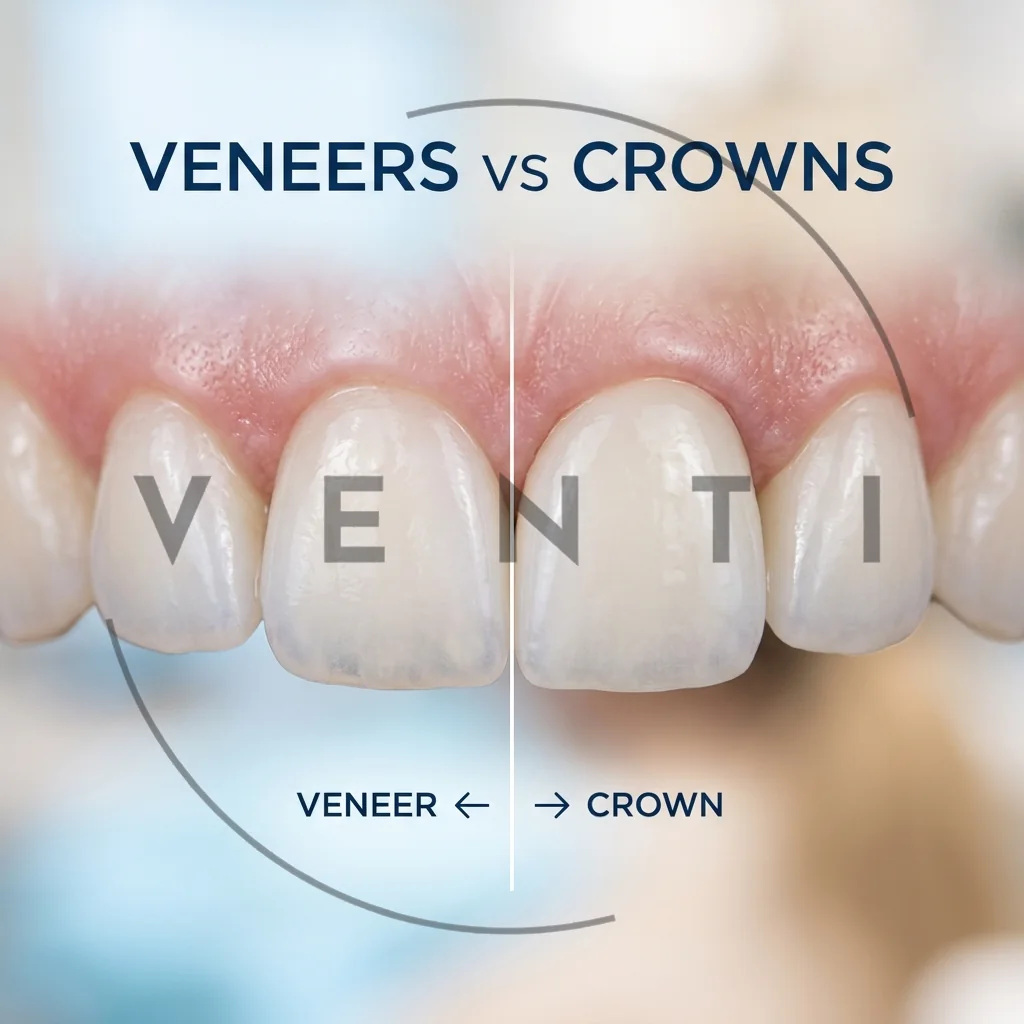
Choosing between veneers, crowns, and Lumineers can feel overwhelming, especially when each promises a brighter, straighter smile. The truth is that these three restorations solve different problems, and the right choice depends on how much of your tooth needs covering, how much enamel you want to preserve, and what you ultimately want your smile to look like. This guide breaks down the real differences in plain language so you can walk into your consultation knowing exactly what questions to ask.
What’s the difference between veneers, crowns, and Lumineers?
A traditional veneer is a thin porcelain shell (roughly 0.5–1mm) bonded to the front of a tooth after a small amount of enamel is removed, a Lumineer is an ultra-thin no-prep veneer (about 0.2mm) that requires little to no enamel reduction, and a crown is a cap that covers the entire tooth on all sides. The core distinction is coverage and tooth preparation.
Think of it as a spectrum of how much of your tooth is involved:
- Lumineers — Cover only the front surface, almost no drilling. Best for minor cosmetic changes on healthy teeth.
- Traditional veneers — Cover the front and biting edge, requiring light enamel shaping for a flush, natural fit and stronger color masking.
- Crowns — Encase the whole tooth, restoring both appearance and structural strength.
Lumineers are technically a brand-name type of veneer, but in everyday conversation patients use the word to mean any thin, no-prep veneer. The defining feature is thickness: the thinner the shell, the less natural tooth structure must be altered, but the less it can hide darker underlying tooth color.
Are Lumineers better than traditional veneers?
Lumineers are not universally better than traditional veneers; they are better in specific situations where minimal enamel removal matters most, such as correcting small gaps, slightly worn edges, or mild shape irregularities on already light-colored, healthy teeth. Traditional veneers win when you need to mask deep stains or make larger cosmetic corrections.
The decision usually comes down to what’s beneath the surface. Because Lumineers are so thin, they can struggle to fully conceal dark or discolored teeth, the shadow can show through. Traditional veneers, being thicker and bonded after light preparation, provide better opacity and a more seamless blend with surrounding teeth.
When no-prep Lumineers are the smarter choice
- Your natural teeth are already a healthy shade and just need minor reshaping
- You want a fully reversible or minimally invasive option
- You’re closing small gaps or smoothing slightly uneven edges
- You’re anxious about drilling and want to preserve maximum enamel
When traditional veneers perform better
- You have tetracycline staining, dark spots, or root-canal discoloration
- You need to correct crowding, rotation, or noticeable size differences
- You want a long-term, durable result with the most natural translucency
- Your teeth protrude or need to be brought into better alignment
An experienced cosmetic dentist will assess your enamel thickness, bite, and tooth color before recommending one over the other, sometimes combining approaches across different teeth.
When do you need a crown instead of a veneer?
You need a crown instead of a veneer when a tooth is structurally compromised, such as after a root canal, a large filling, a fracture, or significant decay, because a veneer only covers the front surface and cannot reinforce a weakened tooth. Crowns protect the entire tooth from cracking under chewing forces.
Veneers are a cosmetic upgrade for fundamentally sound teeth. Crowns are restorative, they rebuild and protect teeth that have lost too much structure to survive on their own. If your dentist sees that a tooth is cracked, heavily filled, or hollowed out after endodontic treatment, a crown is the safer, longer-lasting answer.
Common situations that call for a crown:
- A tooth that has had a root canal and is now brittle
- Large old fillings that leave little healthy tooth around them
- Cracked or broken teeth that need full coverage
- Severely worn teeth from grinding (bruxism)
- Teeth supporting a dental bridge or capping an implant
Many full-smile transformations actually use a mix, veneers or Lumineers on the visible, healthy front teeth and crowns on teeth that need structural support. A skilled team color-matches everything so the final smile looks uniform regardless of what’s underneath.
Do veneers ruin your natural teeth?
Veneers do not ruin your natural teeth when planned and placed correctly, but traditional veneers are not fully reversible because a thin layer of enamel is permanently removed, while no-prep Lumineers preserve nearly all enamel and can sometimes be removed. Honest expectation-setting here matters more than marketing claims.
Here’s the truthful breakdown:
- Traditional veneers involve removing a small amount of enamel, which does not grow back. Once you start, the tooth will generally always need a veneer or similar covering. This is a reasonable trade-off for most people, but it is a permanent commitment.
- Lumineers / no-prep veneers remove little or no enamel, making them the most conservative and the most reversible option.
- Crowns require the most tooth reduction of all three, but they’re used on teeth that already need significant restoration.
The key to protecting your natural teeth is conservative, precise preparation by an experienced dentist, well-sealed margins to prevent decay underneath, and good ongoing hygiene. Poorly fitted restorations, not the concept of veneers itself, are what cause problems like gum irritation or recurrent decay. Choosing a meticulous clinic is the single biggest factor in keeping your underlying teeth healthy for decades.
How long do veneers, crowns, and Lumineers last?
High-quality porcelain veneers and crowns typically last 10–20 years or more with good care, while Lumineers generally last around 10–20 years as well, though their thinness can make them slightly more prone to chipping under heavy bite forces. Longevity depends far more on habits and craftsmanship than on the restoration type alone.
What actually extends the lifespan of any restoration:
- Daily brushing and flossing to keep margins decay-free
- Wearing a night guard if you grind or clench your teeth
- Avoiding using your teeth as tools (opening packages, biting nails)
- Regular professional cleanings and check-ups
- High-grade materials like layered porcelain or zirconia
Crowns made from zirconia or premium porcelain are extremely durable and are the workhorses of full-mouth restorations. Veneers can last just as long when patients protect them from excessive force. The single most overlooked factor is grinding, an unprotected bruxism habit can shorten the life of even the best restoration, which is why a quality clinic always evaluates your bite before treatment.
How much do veneers, crowns, and Lumineers cost, and why does Istanbul change the math?
In the United States, veneers and crowns commonly run from around $1,000 to $3,000+ per tooth, meaning a full smile can reach $20,000–$50,000, whereas Istanbul clinics offer the same premium porcelain and zirconia work at a fraction of that, often making travel, accommodation, and treatment together cheaper than US treatment alone. The savings come from lower operating costs, not lower quality.
Because a full set of restorations is a major investment, the per-tooth difference adds up dramatically across a whole smile. Istanbul has become a global hub for cosmetic dentistry precisely because patients can access internationally trained dentists, modern materials, and digital smile design at significantly lower prices, while turning the trip into a recovery-friendly stay.
Many international patients also combine treatments to maximize the value of a single trip. If you’re considering more than one procedure, our combined hair transplant and dental makeover in Istanbul package lets you address both your smile and your hairline in one coordinated journey, saving time and travel costs.
Because every smile is different, the exact number of teeth, the materials, and any structural work needed all affect your final price. Rather than quoting a one-size-fits-all figure, we provide a personalized plan after reviewing your photos. Book a free consultation to receive a transparent, itemized estimate tailored to your goals, with no obligation.
Frequently Asked Questions
Can I get veneers on just one or two teeth?
Yes, veneers can be placed on a single tooth or a few teeth, though color-matching to your natural teeth is critical for a seamless look. Many patients choose to treat just the visible front teeth in the “smile zone” rather than the entire mouth.
Are veneers and crowns painful to get?
The procedures are performed under local anesthesia, so you shouldn’t feel pain during treatment. Mild sensitivity or gum tenderness for a few days afterward is normal, especially with traditional veneers and crowns that involve tooth preparation.
Can I mix veneers, Lumineers, and crowns in the same smile?
Absolutely, combining restorations is very common and often ideal. Healthy front teeth may get veneers or Lumineers while structurally weak teeth receive crowns, and a skilled dentist blends the shades so the entire smile looks consistent and natural.
Will my insurance cover cosmetic veneers or Lumineers?
Most US dental insurance considers veneers and Lumineers cosmetic and does not cover them, though crowns may be partially covered when medically necessary. This is part of why many patients explore affordable options abroad for purely cosmetic work.
How long does treatment take if I travel to Istanbul?
A full smile makeover with veneers or crowns typically requires about 5–7 days in Istanbul, allowing time for design, preparation, and final placement. No-prep Lumineer cases can sometimes be completed faster, depending on lab timing.
